Montag, 25. Juli 2011

Lisa does it Doggy Style

My uncle has got a dog. The dog’s actually a She, and She’s called Lisa.

Lately my uncle was unavailable for a couple of days, and amongst others I had the pleasure of taking care of Lisa.

Lisa is a nice dog. Indeed, a very, very nice dog. Lisa doesn’t bark, she doesn’t slobber, and she doesn’t beg for food at the table. Lisa knows exactly what she wants. But she also knows exactly what she doesn’t want. And that’s where it gets interesting: Not only does she not do things she doesn’t not want to do, but she really develops extraordinary problem solving skills and very interesting solutions.

For example, Lisa doesn’t like rain. Maybe it’s got something to do with the fragrance ‘Wet Dog’. On the other hand she always likes a refreshing bath in a pond or a lake, and she likes to swim a lot… So, it rains, and Lisa needs to go out. Certain natural things even happen with dogs. Of course it gets a bit difficult with solving problems here, even the hardest dog’s will doesn’t really have a chance against rain. Lisa minces around under the patio and gives me begging looks: ‘Would you please turn off the water, I need to go poo…!’

Lisa likes sticks! She likes to retrieve them, but most of all she likes to chew them. But Lisa doesn’t like artificial bones. You know, these things made of some sort of animal skin, which you can find in supermarkets next to pet food. At the first try, to give her such a thing, Lisa immediately dropped it to my feet, with this distinctive ‘eek’-look in her eyes. After a couple more tries, she finally took the bone and disappeared with it – just to dig a hole in the garden and burry the bone in there. And of course she returned afterwards, looking at me with a look of reproach to tell me: ‘I put it in a safe place, where it can’t be found anymore. But don’t even think about giving such a thing to me ever again!’

lisa

Mein Onkel hat einen Hund. Der Hund ist eine Sie, und Sie heisst Lisa.

Mein Onkel war kürzlich für ein paar Tage nicht abkömmlich, und nebst anderen hatte ich das Vergnügen, Lisa in dieser Zeit zu betreuen.

Lisa ist ein lieber Hund. Ein wirklich sehr, sehr lieber Hund. Lisa bellt nicht, sabbert nicht, und sie bettelt auch nicht um Essen. Lisa weiss sehr genau, was sie will. Sie weiss aber auch sehr genau, was sie nicht will. Und hier wird’s interessant: Nicht nur sträubt Lisa sich gegen Dinge, die sie nicht will, sondern sie entwickelt auch teilweise komplexe und höchste interessante Lösungsansätze.

Lisa mag zum Beispiel keinen Regen. Liegt vielleicht an der Duftnote ‚Nasser Hund‘. Andersrum hat sie aber nichts gegen ein erfrischendes Bad in einem Weiher oder See, und sie schwimmt auch gerne und gut… Nun, es regnet also, und Lisa müsste Gassi gehen. Schliesslich verlangt die Natur auch beim Hund ihr Recht. Jetzt wird’s natürlich schwierig mit der Problemlösungsstrategie, gegen Regen hat auch der stärkste Hundewille keine ernstzunehmende Chance. Sie tänzelt ungeduldig unter dem Vordach umher und wirft mir ab und zu bettelnde Blicke zu: ‚Stell doch bitte mal das Wasser ab, ich muss aufn Topf…!‘

Lisa mag Stöckchen. Sie apportiert sie auch sehr gerne, aber am allerliebsten knabbert sie dran rum. Lisa mag aber keine künstlichen Hundeknochen. Ihr wisst schon: Diese harten Dinger aus irgendwelchen Tierhäuten oder so, die man im Warenhaus beim Tierfutter findet. Beim ersten Versuch, ihr so ein Teil anzudrehen, lässt sie mir den Knochen sogleich lustlos vor die Füsse fallen, mit einem deutlichen Igitt-Blick in den Augen. Nach ein paar weiteren Versuchen nimmt sie den Knochen dann doch – und geht damit nach draussen wo Sie ihn im Garten vergräbt, damit er verschwunden ist. Dann kommt sie aber ganz sicher zurück und schaut mich mit einem vorwurfvollen Blick an um zu sagen: ‚Ich hab das Ding jetzt an einen sicheren Ort versorgt. Aber denk nicht mal dran, mir noch einmal sowas mitzubringen!‘

Sonntag, 17. Juli 2011

The Blitz

For my first composing-project after the long break due to school I chose something similar to the project I ended with last year: A lightning.
Last year it was the big clock in a shopping mall in Victoria, BC, Canada, this time it's a landscape I changed into a thunderstorm-picture. Nice to know: The two pictures are less than a one-hour walk apart from each other, and they have been taken within a couple of hours at the same day. ET and I walked the Beacon Hill Park in Victoria that grey Saturday morning, which is directly at the Juan de Fuca Straight on the south end of the city. When it began to rain, and also because we were hungry, we went to the shopping mall to get something to eat.

Für mein erstes Composing-Projekt nach der Schul-Pause habe ich dort angefangen, wo ich vor mehr als einem Jahr aufgehört habe: Ein Blitz.
Letztes Jahr war es die grosse Uhr in einer Shopping Mall in Victoria, BC, Kanada, diesmal ist es ein Landschaftsbild das ich in ein Gewitterbild verändert habe. Interessantes Detail: Die beiden Schauplätze liegen nicht mal eine Stunde zu Fuss voneinander entfernt, und sie sind innerhalb weniger Stunden entstanden. ET und ich sind an diesem trüben Samstagvormittag durch den Beacon Hill Park in Victoria spaziert, der direkt an der Juan de Fuca Straight im Süden der Stadt liegt. Als es dann angefangen hat zu regnen, und auch weil wir Hunger hatten, sind wir dann in die Shopping Mall gegangen und haben etwas gegessen.

About the picture:
First of all I created a single lightning. This is no problem; it takes just a couple of filters in Photoshop.
With extreme levels and a bit of masking a realistic looking lightning evolves, without taking a picture of a real lightning - which is extremely difficult and needs a huge pile of luck.
Nun zum Bild:
Zuerst habe ich einen einzelnen Blitz erzeugt. Mit ein paar Effekten in Photoshop ist das überhaupt kein Problem.
Mit einer extremen Tonwertkorrektur entsteht ein realistisch aussehender Blitz, ohne dass ich einen echten Blitz fotografieren muss - das ist nämlich verdammt schwierig und man braucht auch eine gehörige Portion Glück dazu.

blitz1blitz2

As you can see here, the original picture is too dark. But this highlights the clouds.

Wie hier zu sehen ist, ist das Bild unterbelichtet. Dies hebt aber die Wolken besonders hervor.
gewitter1

In a first RAW-processing I darkened the picture even more.
In einer ersten RAW-Konvertierung habe ich die Wolken noch einmal etwas düsterer gemacht.
gewitter2

In a second RAW-processing I lightened up the landscape, otherwise you could think the picture was taken by night.

In der zweiten RAW-Konvertierung wird nun die Landschaft aufgehellt, damit das Bild nicht aussieht als wenn es bei Nacht gemacht worden wäre.
gewitter3

Let's place the lightning into the landscape; this also takes some alignment and masking.

Den Blitz ins Landschaftsbild gesetzt, ausgerichtet und noch etwas maskiert.
gewitter4

Now I coloured the lightning with a blue hue, which makes it look a bit more realistic.
To top that, I put in a little bit of shine into the clouds, where the lightning comes from, and on the lighthouse, which it hits. I didn't put in any rain or wind, because that would distract the viewer and steal away a good deal of the dramatic of the picture.
Nun wird der Blitz noch leicht blau eingefärbt, das lässt ihn noch realistischer aussehen.
Das Tüpfelchen auf dem I sind der Lichtschimmer in den Wolken, wo der Blitz herkommt, und der erleuchtete Leuchtturm, wo er einschlägt. Auf Regen und Wind habe ich verzichtet, da dies vom eigentlichen Bild ablenken und dem Bild viel von seiner Dramatik nehmen würde.
gewitter5

At the end I put a light blue hue over the whole pictures, which makes it look like the lightning lit it up a bit. But again the pictures now looks like it's been taking by night, although it was 9.30 in the morning.
Zum Schluss habe ich noch einen blauen Schimmer über das ganze Bild gelegt, so als würde der Blitz die ganze Szenerie erleuchten. Natürlich erweckt auch dies wieder etwas den Eindruck von Dunkelheit, obwohl das Bild um 9.30 am Morgen aufgenommen worden ist.

gewitter6


For the finale I used the smart sharpener, which makes the picture almost jump at the viewer.
Für den finalen Effekt sorgt der selektive Scharfzeichner, der dafür sorgt das das Bild den Betrachter beinahe anspringt.
gewitter7

Some words about the equipment used: I took the picture with my Nikon D300; the lens was a 16-85 mm f/3.5-5.6. The focal length was 48 mm, aperture f/4.9, the shutter was on automatic.

Ein paar Worte noch zur Ausrüstung: Ich habe das Bild mit meiner Nikon D300 aufgenommen, das Objektiv ist ein 16-85 mm f/3.5-5.6. Die Brennweite beträgt 48 mm und die Blende war auf f/4.9 gestellt, die Belichtungszeit wurde automatisch geregelt.

Samstag, 16. Juli 2011

Welcome Back - Willkommen zurück!!!

It's been more than 14 months since I wrote the last entry in this blog. That's an awful lot of time, especially in today's fast moving world, and I'm glad to be back today! A lot has happened, some things have changed, and I will try to put things into a useful order.
First of all, the reason for my absence: I did some advanced training and became a Sales Specialist. To give you an idea what that means and what I've learned, let's put it that way:
I can now run the branch office of a store or shop. Or I could work as a Key Account Manager now. Or as the team-leader of a sales-team, back office or field service. Some CEO might even employ me as a Sales Manager, although I didn't become a Sales Manager which is just the odd step higher on the career-ladder.
What have I learned? Well, a lot.
Sales planning, for example: Given the correct facts and figures, I could plan the expansion of a company abroad. I can tell you which products would make sense for different target audiences, how many sales points and branch offices we need, or - if we work with independent trade channels - how many field agents we need.
Clearly I can calculate prices from the expense distribution sheet, including margins, breakeven-point, priority of products, and calculation by equivalent value, contribution margin accounting and other nasty stuff with numbers.
Of course I could also calculate forecasts and regression coefficients. Or set up complete sales statistics, including averages, standard deviation and coefficient of variation (I love my TI-36XII!!!), brightly coloured diagrams and meaningful tables with loads of numbers, all classified for better clarity.
Not to forget that I can plan sales promotions from definition of target audience, over target definition, right down to corrective actions, same thing goes for advertising campaigns and general marketing.
Oh yes: Distribution! This was my strongest subject! I can now plan the distribution of products and service with SWOT-analysis, over utility value analysis, calculation of numeric and weighted distribution, logistics and strategic distribution.
Also I could talk you to sleep with a lecture about management (by delegation, objective, helicopter, kangaroo, jeans, hippo and other funny things…), market research, and sales psychology.
And last but not least I could also give you a lecture about Swiss engineered sports clothing that copies several features and the name of a little white fox that lives in the desert, but that's another story…
There's just one tiny little snag: I didn't pass the federal exams. This means, I'm still a sales specialist, but not federally certified. Of course it would be possible to repeat the exams, and the school where I took the classes offers a special price for repetitions. But the exams cost the same, and together that's quite a pile of money - which I'd rather spend on something else.
So, what did I get in the end? Well, first of all - as I said - I got a certificate from school, which says that I'm a sales specialist, though it doesn't give any 'real' qualification. Also I gained several new contacts and colleagues, which is always good to have. It gives you some kind of network.
Also: I can blog.
I can take photographs.
I can photoshop.
I can go cycling.
I can re-join my old friends in the forums.
I can go to the zoo.
I can go to the botanic gardens.
I can soar the virtual skies of Microsoft's Flight Simulator.
All this gives more value to me than the simple phrase 'eidg. Fachausweis' written on a sheet of paper.
In short: I GOT MY OLD LIFE BACK!!!

Expence calculation sheet and other stuff with numbers

Es ist jetzt mehr als 14 Monate her seit ich den letzten Eintrag in diesem Blog geschrieben habe. Das ist eine verdammt lange Zeit, speziell in unserer schnelllebigen Welt, und ich bin froh heute zurück zu sein. Viel ist passiert seither, einiges hat sich verändert, und ich möchte versuchen die Dinge einigermassen in eine sinnvolle Reihenfolge zu bringen.
Zu allererst, der Grund für meine Auszeit: Ich habe eine Weiterbildung besucht und bin jetzt Verkaufsfachmann. Um Euch eine Idee zu geben, was das genau heisst und was ich dabei gelernt habe, lasst es mich mal so beschreiben:
Ich kann jetzt die Filiale eines Geschäftes leiten. Oder ich könnte als Key Account Manager arbeiten. Oder als Leiter eines Verkaufsteams, im Innen- oder Aussendienst. Einige Geschäftsführer können mich sogar als Verkaufsleiter einstellen, obwohl ich nicht Verkaufsleiter bin was noch etwa eine Stufe höher auf der Karriereleiter angesiedelt ist.
Was hab ich gelernt? Nun, vieles.
Verkaufsplanung, zum Beispiel: Mit den entsprechenden Zahlen und Fakten ausgerüstet, könnte ich die Expansion einer Firma ins Ausland planen und durchführen. Ich kann Euch genau sagen, welche Produkte Sinn machen für verschiedene Zielgruppen, wie viele Zweitstellen und Filialen wir brauchen, oder - wenn wir mit unabhängigen Absatzmittlern arbeiten - wie viele Aussendienstmitarbeiter wir brauchen.
Sicherlich kann ich jetzt auch Preise kalkulieren anhand des Betriebsabrechnungsbogens, inklusive Absatzmargen, Nutzschwelle und Produkt-Priorisierung, und Kalkulationen mit der Äquivalenzziffer machen, Deckungsbeitragsrechnungen und andere wirklich wichtige Dinge mit Zahlen anstellen.
Natürlich kann ich auch Vorhersagen und Regressionskoeffizienten berechnen. Oder komplette Verkaufsstatistiken, inklusive geometrische Mittel, Standardabweichung und Variationskoeffizienten (ich liebe meinen TI-36XII!!!), Diagramme in den schönsten Farben und bedeutungsschwangere Tabellen mit tonnenweise Zahlen, alle in Klassen geordnet für eine bessere Übersichtlichkeit.
Nicht zu vergessen ist, dass ich auch komplette Verkaufsförderungsaktionen durchführen kann, von der Situationsanalyse, über die Zieldefinition bis hin zur Nachkontrolle. Dasselbe gilt auch für Werbekampagnen und das klassische Marketing.
Ach ja: Distribution! Das war mein stärkstes Fach! Ich kann nun die Distribution von Produkten und Dienstleistungen planen, mit SWOT-Analyse, Nutzwertanalysen, Berechnung von numerischer und gewichteter Distribution, Marketinglogistik und strategischer Distribution.
Natürlich kann ich Euch auch mit einem Vortrag über Managementansätze einschläfern (Management by delegation, objective, Helikopter, Känguru, Jeans, Nilpferd und andere wüste Dinger…), dasselbe gilt auch für Marktforschung und Verkaufspsychologie.
Und nicht zuletzt könnte ich Euch auch einen Vortrag halten über in der Schweiz entwickelte Sportbekleidung, die diverse Eigenschaften eines kleinen weissen Fuchses aus der Wüste kopiert hat, aber das ist eine andere Geschichte…
Die Sache hat nur einen klitzekleinen Haken: Ich hab die eidgenössische Prüfung nicht bestanden. Das heisst, ich bin zwar Verkaufsfachmann, aber nicht mit eidg. Fachausweis. Natürlich wäre es möglich, die Prüfung zu wiederholen, und die Schule an der ich gelernt habe macht auch ein spezielles Angebot für Repetenten. Aber die eigentliche Prüfung kostet noch mal so viel wie letztes Mal, und das ist ein ziemlicher Haufen Geld - welches ich lieber für andere Dinge ausgebe.
Was bleibt also unter dem Strich? Nun, wie bereits gesagt: ich hab den Wisch der Schule, auf dem steht dass ich Verkaufsfachmann bin, aber das gilt nicht als ‚echte' Qualifikation. Und ich hab mir ein Netzwerk mit neuen Kontakten und Kolleginnen und Kollegen aufgebaut, und das ist auch eine ganze Menge wert.
Ausserdem: Ich kann wieder bloggen.
Ich kann fotografieren.
Ich kann photoshoppen.
Ich kann radfahren.
Ich kann mich mit meinen Freunden in Foren herumtreiben.
Ich kann in den Zoo gehen.
Ich kann in den botanischen Garten gehen.
Ich kann im virtuellen Himmel von Microsofts Flight Simulator cruisen.
Dies alles ist mir mehr wert als der kleine Eintrag ‚eidg. Fachausweise' auf einem Stück Papier.
Kurz gesagt: ICH HAB MEIN ALTES LEBEN ZURÜCK!!!

Bücher mit bedeutungsschwangeren Titeln

Samstag, 8. Mai 2010

The Clock

Hello and welcome to the world of Photoshop! With some time at hand between working at the office, going to school and doing homework, I decided to create something new with a picture I took during my wonderful holiday in Vancouver and Victoria, Canada.

clock_normal

The original picture shown a pitoresque clock in a shopping mall in Victoria, B.C., and after a couple hours of work I came out with a version that looks a bit like having emerged from a scary movie, where an android from the future lands in present time and then goes to commandeer a denim and leather outfit together with black sunglasses and a Harley Davidson motorcycle, and comes up with the line ‘I’ll be back’ at least once throughout the movie…

clock_flashes

Sonntag, 24. Januar 2010

Airbus A380 and other ugly planes

On January 20th the brand new Airbus A380 approached Zurich for the first time. 23’000 people watched the show.


Several mates from work asked me why I didn’t go and take a few pictures. Here are my reasons:

1. I expected that there would be too many people around, and I don’t really like such crowds unless it’s the concert of one of my favourite bands.

2. Beginning with the summer-schedule Singapore Airlines flies to Zurich with the A380 every day, instead of two flights per day with the Boeing 777.

3. For me the A380 is not really a beautiful airplane. I think it looks like a sperm whale suffering from flatulencies…

Now, ugly airplanes have something like a long tradition, and here’s where I want to get to with this post. I’m not talking about the Boeing B757 with its slightly distorted proportions. There is worse in the history of airplanes.

A little historical flashback brings us to Everett WA in the year 1947. Commercial aviation is at the dawning of a new era. The Douglas Aircraft Company introduced their DC-4, which evolved from the C-54, and that was the first land-placed commercial airplane that could cross the Atlantic in a nonstop flight. Lockheed followed with the L-1049 Constellation – which in fact is one of the most elegant airplanes ever built.

Boeing had nothing to offer, as they had only built bombers during the war, the last being the B-29. Not the worst in ugly airplanes, but the cause is wrong: Dropping bombs onto other people just isn’t a nice thing to do... Instead of developing a completely new airplane, Boeing took the highly efficient, supercritical shaped wing of the B-29, mounted bigger Pratt &Whitney Wasp engines, and mounted it to a fuselage-construction never seen before: A widened B-29 fuselage was mounted on top of a standard fuselage, in front view the construction looked like an 8. The result was a freighter called C-97 Stratofreighter. The passenger-version was named B-377 Stratocruiser. Ugly enough?

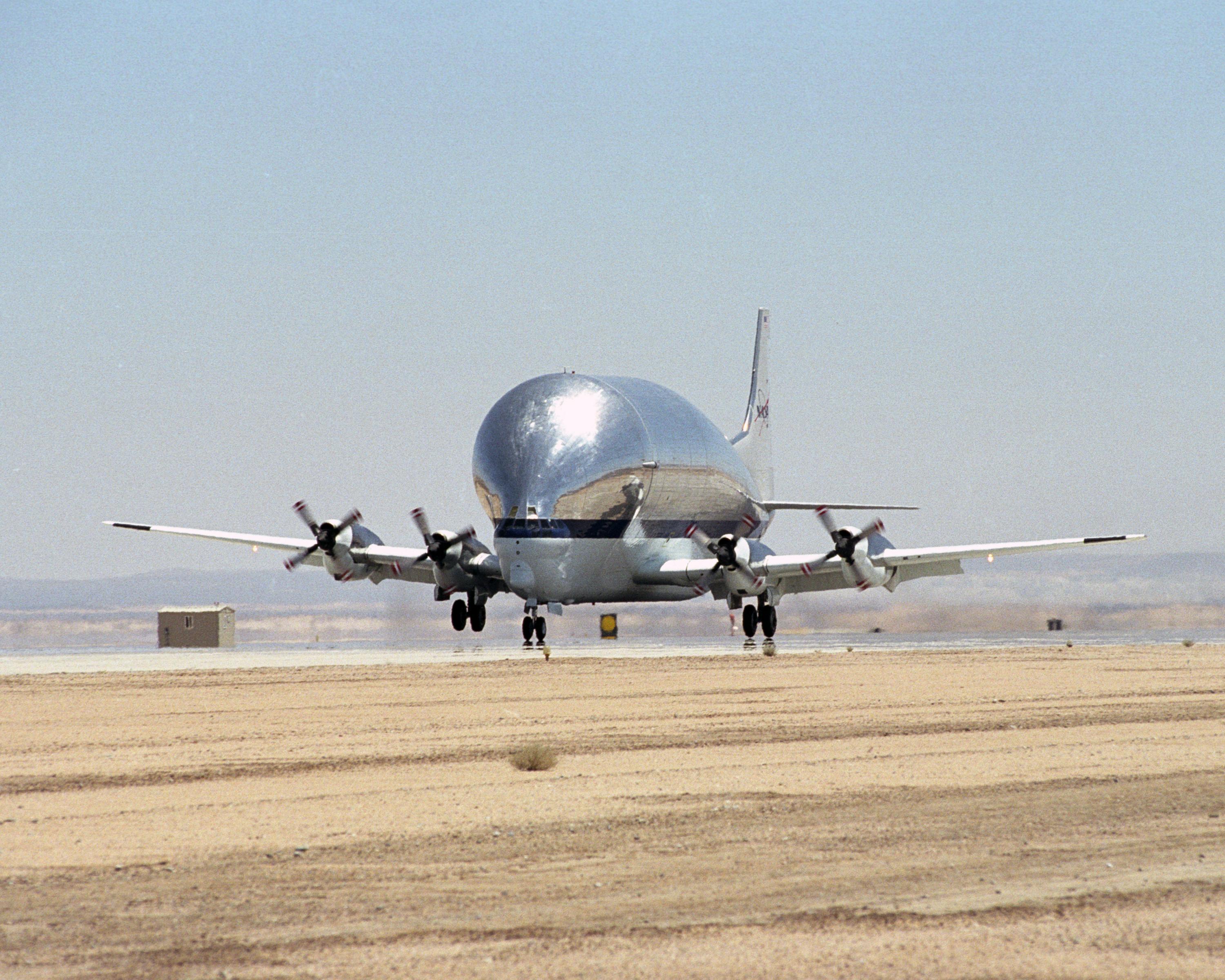
Certainly not! When NASA started shooting apes into space with rockets, the need of a super-transporter to fly the rocket-segments from their building-site to the launch-site at Cape Canaveral became evident. A leading engineer of Conroy Aircraft once saw a Stratocruiser and thought, if it was possible to convert a B-29 into something like that, it would probably also be possible to build a much larger plane with the same airfoil. The result had such extreme proportions and was so ugly, that many aviation experts proved to be fish experts as well and called the plane ‘Pregnant Guppy’. The official name then was B-377PG. Further versions were then called B-377SG (Super Guppy), a version powered by turboprop engines was known as B-377TG (Turbine Guppy).


And here’s the catch to it: If you look very close, you’ll recognize certain similarities between the A380 and the Guppy-series...

Donnerstag, 26. November 2009

Wicked Number Seven


In Christianity 7 is a lucky number:

- 7 days of Creation. God rested on the 7th day.
- 7 years of plenty and 7 years of famine in the Pharao's dream.
- 7 days of the feast of Passover.
- 7 last sayings of Jesus on the cross.

Thank you Wikipedia for this.

What about this on my blog? Well, as I always like to point out: A Pflight's gotta do what a Pflight's gotta do (thank you John Wayne for this).

Yesterday I bought a new computer, it's called Leader VII Pro. And guess what: It's the 7th computer I've owned: So far I've had one Apple Macintosh Performa 75 (all-in-one), 2 PC's running on Windows 4 (Windows 98se, Windows ME), 2 PC's running on Windows XP, one Notebook running on Windows XP, and one Notebook running on Windows Vista Ultimate.

And here comes Number Seven: It's got an Intel i7 CPU, and it's running on a 64bit Windows 7 Home Premium.

Donnerstag, 15. Oktober 2009

DRI-Panorama

I just tried out some new software. The pictures were taken at night out of my living-room window. This was my workflow: I took three sets of three pictures, exposure 30", 15" and 5", aperture f:5.0. The three sets were processed with the Photomatix DRI-tool, then the panorama was created using PTGui. The last steps were done in Photoshop CS4: Increasing contrast, and sharpening. For those who have been here before: What you see used to be our lawn with apple-, pear- and nut-trees.

Von PFlight2000 - Soaring through Life in Switzerland

Donnerstag, 27. August 2009

COW

Don't text while driving! That's the message the Gwent (Wales, UK) Police Department wants to send to us. And I think in this format the message is VERY clear: Cassie Cowan kills 4 people in a car accident because she gets distracted by using her cellphone while driving.

Be warned: What you are about to see is EXTREMELY GRAPHIC!!!!!


And here's NBC's The Today Show on that topic:

Sonntag, 16. August 2009

Colléction Schlumpf, Mulhouse

Hans Schlumpf ran a yarn factory in Mulhouse. His factory held the monopoly for rough yarn all over France, which gave him absolute control of the market for this yarn. That made him a wealthy man. Unfortunately he and his brother Fritz had a very expensive hobby: They collected cars. Old cars. Antique cars. And here comes the sad story: Not only did they spend every single penny of their own pile into their car collection, they also used money from Hans’ company to buy more and more cars. In 1977 the company went bankrupt, leaving over 2000 people without a job. At a raid during a strike in 1977 the mob discovered the 400+ cars. Selling all these vehicles – the oldest was built in 1886 – would have brought all the money to pay the company’s debts. But the French government insisted and turned the old factory halls into a museum, the ‘Cité d’Automobile’, City of Cars.
The vast majority of the cars in the collection are French built cars, such as: 19 Panhard & Levassor, 19 Renault, 29 Peugeot etc, etc. But the highlight of the museum are 123 Bugattis. Amongst them are 2 Type 41 Royale from the original Schlumpf Collection, and a replica of a third one. Only six of these wonderful automobiles where ever built.


Here are some of the highlights of the museum:

Bugatti Type 35
If anybody hadn't heard about Bugatti cars in 1924, this changed with the Type 35. Approx. 200 of all variants were built, more than 2000 races were won until 1930. Bentley, Alfa-Romeo, Mercedes, you name it, Bugatti beat it with this car. This was the car that finally created the legend of the brand.


Von Colléction Schlumpf


Von Colléction Schlumpf


Bugatti Type 41 Royale
Built for Royals, but none of them were interested... Only 6 cars were built in total, two of them are exhibited in Mulhouse, also the replica of the Royale Roadster.


Von Colléction Schlumpf


Von Colléction Schlumpf


Bugatti Type 46
The Type 46 from 1929 was a direct hit against the Mercedes-Benz SS and the Hispano-Suiza H6B. Its 5.3 liter engine was smaller than the engines of the opponents, but Bugatti had enough expertese to make up for that with power and stamina. And of course the body looked like the american cars of that time. The car was also known as 'Petit Royale'.


Von Colléction Schlumpf


Bugatti Type 50 T
Had the Type 46 established the brand Bugatti all over the world - the Type 50 should now prove that this wasn't just by accident. 'Le Patron' Ettore brought his 20 year old son Jean into the company, and he was responsible for rhis construction and for the breathtaking design of the T-Todel. The 'normal' Type 50 raced the 24 heurs du Mans 4 times, but none of the cars ended the race, mainly because of damaged tires. This was also a problem for the T-Model, as the engine produced 275 hp which was too much for the tires.


Von Colléction Schlumpf


Bugatti Type 57
Ettore Bugatti's son Jean built this car, and also designed some of the most spectacular carbodies of all times for it. The bodies Ventoux, Galibier, Stelvio and especially the breathtaking Atlantic Coupé, of which only a handful were built, remain unforgetable.

Type 57 C Galibier:

Von Colléction Schlumpf


Atlantic Coupé - extremely rare!

Von Colléction Schlumpf


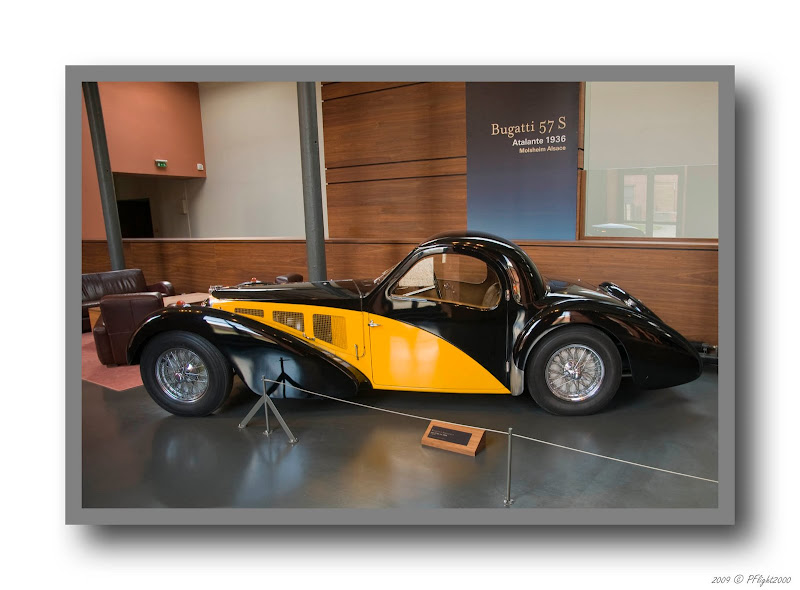
The replica of the famous Type 57S Atalante Coupé:

Von Colléction Schlumpf


Bugatti Type 101
After Ettore's death in 1947 the company only built one more model. But without the genius on the helm, the car remained unsucessful. Actually the company missed to do new developments, and so this car was basically a Type 57 with a new body - so the car was basically 25 years old when actually came out...


Von Colléction Schlumpf


This Type 101 obviously does not have its original body anymore. It's been redesigned by an italian designer.


Von Colléction Schlumpf


Bugatti Type 251
The attempt to build a car for the new 2.5-liter formula ended in a disaster. Although Gioacchimo Colombo - the father of Ferraris pre-1954 12-cyclinder engines - had designed the engine the car lasted only half a race.


Von Colléction Schlumpf


Both Ettore Bugatti and his son Jean had died already years ago, and the small company from Molsheim had financial problems and was taken over by Hispano-Suiza in 1963. In 1966 Simca bought Hispano-Suiza, and the brand Bugatti disappeared.


Bugatti EB 16/4 Veyron
Well, yes, it's a Bugatti... In 1987 Romano Artoli founded the Bugatti International Holding in Luxemburg. He knows people who have money. On September 14 and 15 in 1991 the EB110 is being presented on the Place de la Défence in Paris and in the original factory halls in Molsheim. Many former Ferrari and Lamborghini constructors have worked on the car, but the audience misses the connection with the original Bugattis. 139 cars have been built, plus the prototype of the limousine EB112, when in 1995 the company is going bankrupped. Artoli and his crew have created a financial mess.

When it comes to exotic cars, big brands have the advantage: Ferrari, Alfa Romeo and Maseratti belong to Fiat, Lamborghini once belonged to the Mimram family, before it was sold to Chrysler, then to Mega Tech in Indonesia, and now it belongs to Volkswagen. And Volkswagen also bought the rights of the name Bugatti in 1998. After various design-studies the EB 16/4 Veyron is being presented in 2000, production begins in 2003 in Molsheim - but not in the old factory halls, since they still belong to Hispano-Suiza-Mercier. 16 cylinders, 4 turbochargers, 1001 hp, 406 km/h - that's truly Bugatti-like. Although, not much is left from the myth in this car...


Von Colléction Schlumpf


Ferrari 500 TRC
The Testa Rossa saga began in 1957 and ended in 1962. The concept was to create a competitive open-bodied race-car for gentlemen-drivers, who didn't have the opportunity to race for a factory team. So Testa Rossas were hardly ever operated by the Scuderia Ferrari. The model 500 TRC was actually the last ever Ferrari to have a 4-cylinder engine. The Testa Rossa saga found a follow-up in the timeless ugly 512BB Testarossa from 1984.


Von Colléction Schlumpf


Although looking roughly the same, this car is not a Testa Rossa. The bodyshops Scaglietti and Fantuzzi in Modena used the same design from Pinin Farina for several open-bodied racing cars, so it's very difficult to tell the difference. This one could be a 412MM or a 860 Monza.


Von Colléction Schlumpf


Ferrari 250 GT Lusso
The Ferrari 250 in all its variants marked the beginning of the Golden Age for the italian company with the jumping horse. Most of the cars were designed by Pininfarina, who's name by then still was Pinin Farina. Ferrari built a so-called rolling chassis with the engine, and sent this to Scagliatti, who built the body of the car and the interior. This particular car already showed typical 1970s elements back in the late fifties.


Von Colléction Schlumpf


Ferrari 250 Le Mans
Although not a real 250 model (the number means the ccm per cylindre) but rather a 330, Ferrari tried to cheat the FIA on this one. The car was presented as a race-variant of the 250 SWB from 1959, but really had nothing in common with this one. The FIA found out what had happened, and the car was banned from the 3-litre races. It had to compete with much more powerful opponents, which eventually lead to the legendary P-Series, ending with the 330 P3 and P4.


Von Colléction Schlumpf


Von Colléction Schlumpf


Alfa Romeo 8C 2,9 A
With the 8C - stands for 8 cylinders - Alfa Romeo presented a new generation of sports cars in 1931. The car first had 2300 ccm, in 1936 the engine was enlarged to 2900 ccm. About 30 cars were made of that type, with some of the most elegant bodies ever seen and very typical for that time.


Von Colléction Schlumpf


Arzens La Baleine
Paul Arzens was a French designer who designed many locomotives for the SNCF. Also he constructed two cars: La Baleine and L'Oef. La Baleine was based on the chassis of a Buick, and wich it's streamline shape it was 40 km/h faster than the american original.
This car is not part of the original Colléction Schlumpf, as it was in use until Azens' death in 1990.


Von Colléction Schlumpf


Von Colléction Schlumpf


Trabant 601
How many people do you need to build a Trabant? 5: Four fold the cardboard, one handles the glue...
This car represents more than anything else the lifestyle in the DDR / GDR. It's twin-stroke engine with 600 ccm produced 27 hp, enough for 107 km/h topspeed.
This car is not part of the original Colléction Schlumpf.


Von Colléction Schlumpf


The Group B Monsters
Ford RS200
Peugeot 205 Turbo 16

In 1984 the FIA introduced a new formula into Rally Sports: Group B. I won't bother you with reglementation details, just so much: Allowed was basically everything, as long as you produced 200+ cars of that model. This lead to this legendary Peugeot 205 Turbo 16, with 500 hp, AWD, and a weight of only 900 kg. The engine was mounted in the middle of the car, behind the driver's and copilot's seat. Technically these cars had absolutely nothing in common with the 'original' 205 that populated european streets in the 80s and 90s, the RS200 never even had a 'brother' for normal street use. Once unleashed, the engine turned the care into a rocket on wheels, hardly controllable by its driver. Many fatal accidents within a very short period forced the FIA to bring this adventure to an end in 1986. Never again have so highly overpowered vehicles entered a rally-track, but the thundering sound of the engines, the puffing of the whastegate-valves and the turbine-like whining of the gearbox still brings goosebumps to fans.
These cars are not part of the original Colléction Schlumpf.


Von Colléction Schlumpf


Von Colléction Schlumpf


Here's for some Action:


Mercedes-Benz 300 SL Roadster
After the success of the SSL and the W154 forumla cars back in the 30s Mercedes-Benz tried to catch up to the Ferraris and Porsches after WWII. The result was the 300 SL, which was built as coupes and roadsters, both for normal use and for racing.


Von Colléction Schlumpf


Porsche 962
In the early 80s Porsche dominated the so-called Group C with the model 956 and its successor 962. The engine was an evolution-version of the original 911 engine.
This car is not part of the original Colléction Schlumpf.


Von Colléction Schlumpf


Audi R8
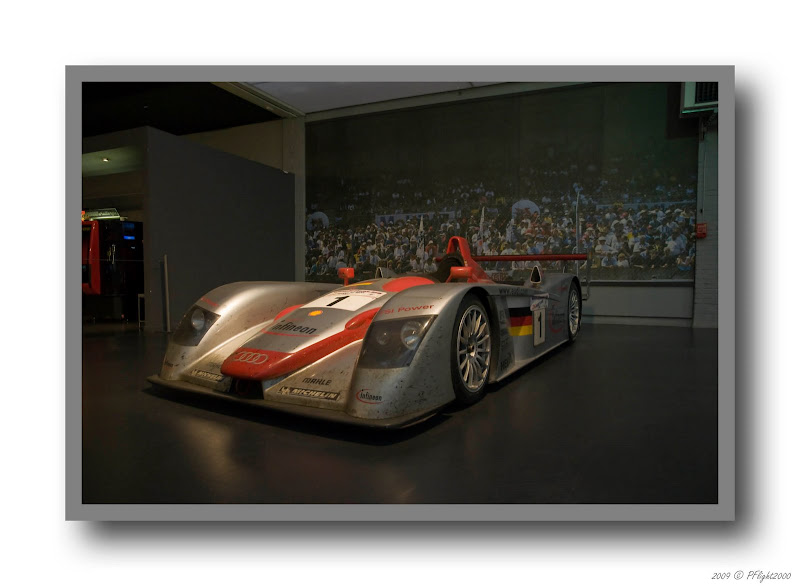
The successor of the Group C in track racing is todays Le Mans Series. The peak of the series is the 24 heurs du Mans, the 24 hour race. The prototypes are the kings of the road, and Audi won the race 6 times with the R8, plus many more races in total.
This car is not part of the original Colléction Schlumpf.


Von Colléction Schlumpf

PS: I appologize for the messup with the name Franco Sbarro in the first version of this blog, and I want to point it out very clearly here: Franco Sbarro had NOTHING to do with the Bugatti-disaster in the early nineties. He was not involved in the EB110 project. His connection with the name Bugatti is a replica of the Type 41 Royale that has been built until 1983.

Freitag, 7. August 2009

PFlight in Alsace

Let's face the facts: A mobile home is a convenient way to spend your holiday on a camping ground. You fill the car with all the stuff you think you might need, like clothes, food, drinks, toiletry, laptop, camera, bicycle, etc, etc, and then you drive to the camping of your choice. If you're lucky enough they have still some place for your vehicle, so you park it, plug in the electricity, turn on the gas for the kitchen, and there you go. Happy camping!

So far, so good. Now, in my case the car was 5.5 meters long, 2 meters wide and 2.3 meters high. The camping ground wasn't the problem. BUT: Imagine you have to drive that thing somewhere because you want to see some of the beautiful cities in the area! I drove over to the beautiful region of Alsace in France, so the plan was to visit Strasbourg for the European Parliament and of course the huge cathedral, and to visit also Colmar for the famous altar of Isenheim, painted by Matthias Grunewald. Believe it or not: I didn't find any parking place in either city where you can park a car higher than 2 meters for longer than 2 hours!!! And if you park there, you really get ripped off! In Colmar these parkings cost twice the price for a normal car parking...

In Strasbourg I parked the car for two hours, rushed for the cathedral for a couple of pictures, rushed back to the car and left the city in frustration. In Colmar I didn't even park, I was so frustrated after searching for a parking for more than an hour, so I left the city without having even really stopped.

I ended up in Mulhouse that day, at the National Car Museum with the huge 'Collection Schlumpf'. I'll tell you more about that later.

At least I spent two wonderful evenings in the beautiful village of Ribeauville. But the short trip left a bit of a bad taste after what I've experienced. One tends to think 'what do you expect from a land where they eat snails and frogs', but that's unfair since my parents experienced the same in Germany and Spain with the very car.

Here are some pics:

A stork walking around in the camping Pierre de Coubertin in Ribeauville
Von Elsass

Dramatic lighting by a nearing thunderstorm in Ribeauvile
Von Elsass

Ruined castle in the distance
Von Elsass

After the thunderstorm
Von Elsass

The next evening showed 25°C and sunshine
Von Elsass

The famous Metzger tower in Ribeauville
Von Elsass

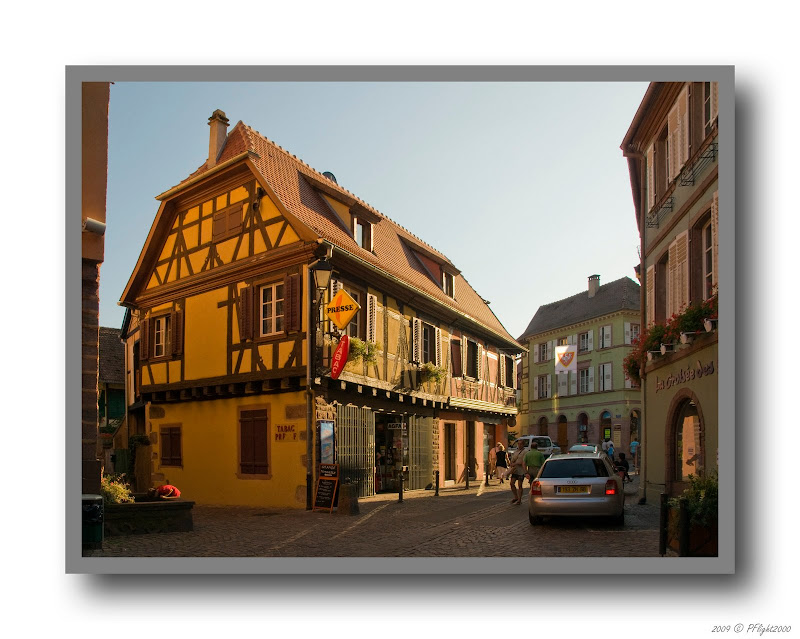
Beautifully lit house: The light comes from the fassade of the next house, which is also painted yellow
Von Elsass

Full moon rising - some of you might know a similar scene, seen about a year ago in West Van
Von Elsass

The giant Munster of Strasbourg - unbelieveable how they managed to build this a couple of hundred years ago!
Von Elsass

The entrance with the huge round window above it
Von Elsass

Beautiful old house next to the cathedral. It's a restaurant now.
Von Elsass
That's it, hope you liked the pics! Pictures of the Collection Schlumpf and the story to that museum follows later.